
Snakk med Silje
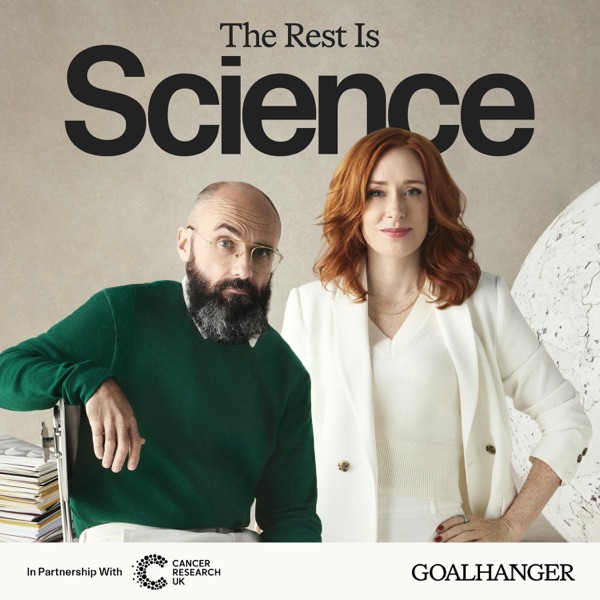
Every week, around three undersea internet cables get damaged badly enough to need urgent repair... and the culprit usually isn’t sabotage. Submarine cables carry more than 99% of the world’s international data, from your video calls to global financial transactions. Yet they lie on the ocean floor, where fishing gear and dragging ship anchors cause huge amounts of the damage. In this episode of The Rest Is Science, Professor Hannah Fry and Michael Stevens (Vsauce) investigate the hidden network of underwater cables holding the internet together, and the problems that come with running it across the bottom of the ocean. How do you lay a cable across an entire ocean? What happens when one breaks miles below the surface? And in the age of satellites, why are we still relying on cables on the seabed? ------------------- For more information about Cancer Research UK, their research, breakthroughs and how you can support them, visit https://cancerresearchuk.org/restisscience Cancer Research UK is a registered…
Every week, around three undersea internet cables get damaged badly enough to need urgent repair... and the culprit usually isn’t sabotage. Submarine cables carry more than 99% of the world’s international data, from your video calls to global financial transactions. Yet they lie on the ocean floor, where fishing gear and dragging ship anchors cause huge amounts of the damage. In this episode of The Rest Is Science, Professor Hannah Fry and Michael Stevens (Vsauce) investigate the hidden network of underwater cables holding the internet together, and the problems that come with running it across the bottom of the ocean. How do you lay a cable across an entire ocean? What happens when one breaks miles below the surface? And in the age of satellites, why are we still relying on cables on the seabed? ------------------- For more information about Cancer Research UK, their research, breakthroughs and how you can support them, visit https://cancerresearchuk.org/restisscience Cancer Research UK is a registered…
Every week, around three undersea internet cables get damaged badly enough to need urgent repair... and the culprit usually isn’t sabotage. Submarine cables carry more than 99% of the world’s international data, from your video calls to global financial transactions. Yet they lie on the ocean floor, where fishing gear and dragging ship anchors cause huge amounts of the damage. In this episode of The Rest Is Science, Professor Hannah Fry and Michael Stevens (Vsauce) investigate the hidden network of underwater cables holding the internet together, and the problems that come with running it across the bottom of the ocean. How do you lay a cable across an entire ocean? What happens when one breaks miles below the surface? And in the age of satellites, why are we still relying on cables on the seabed? ------------------- For more information about Cancer Research UK, their research, breakthroughs and how you can support them, visit https://cancerresearchuk.org/restisscience Cancer Research UK is a registered…
In this 100th episode of The Rest is Science, Michael and Hannah debate whether the number 100 or 101 is superior. They explore various mathematical and historical perspectives, including the etymology of 'hundred', the benefits of base 12, the primality of 101, and the psychological impact of numerical thresholds in human behavior. The conversation further explores the arbitrary nature of the Kármán line at 100 kilometers and the origin of '101' as an introductory course designation. The hosts also discuss scientific phenomena involving element 100 (Fermium) and conclude with a mathematical exploration of Roman numerals being alphabetized.
The hosts explore historical audio recordings, ranging from the earliest known recording of a human voice in 1860 to large-scale crowd recordings from 1888. They discuss the technology behind phonautographs and wax cylinders, as well as the scientific possibility of capturing sound in physical objects like clay pots. The episode also covers the scientific discovery of the BRCA2 gene and investigates mysterious underwater sounds recorded by hydrophones. The discussion details how researchers used modern technology to identify the origins of sounds like the 'Biotwang' and the 'Bloop'.
The hosts explore the complexities of solar time, discussing how Earth's axial tilt and irregular orbit create discrepancies between sundials and standardized civil time. They delve into the mechanics of the equation of time, the concept of sidereal days, and the use of specialized tools like the SunQuest sundial to correct for these astronomical variations. The episode also covers the history of mass-produced sundials and the phenomenon of the subsolar point, specifically 'Lahaina Noon' in Hawaii. The conversation concludes with explorations of planetary proximity calculators, the vastness of the Pacific Ocean, and a philosophical reflection on following one's own rhythm versus societal time.
In this episode of Field Notes, Michael and Hannah explore the intersection of human history, biology, and physics. The discussion begins with the mechanics of squatting, examining how traditional tools like the Kenyan 'ekiholon' and habitual squatting leave physical marks on the human skeleton, as seen in both modern humans and Neanderthals. The episode then transitions into the evolution of chairs and their impact on posture, before diving into the physics of air pressure and motion. The hosts examine the counterintuitive behavior of helium balloons in moving cars and conclude with a look at how gas density affects sound resonance and the rhetorical function of tautologies in language.